
4 minutes
GPR 2026 Trend 1: Payment apps are moving to stores
Payment apps are on track to power 46% of global point-of-sale (POS) value by 2030. Explore what’s driving this, how adoption differs by region and what merchants can do to stay competitive.
Key points:
- Payment apps are moving from “alternative” to expected at the in-store point of sale (POS).
- By 2030, they’re forecast to account for 46% of global POS value ($15.6 trillion).
- Adoption is being accelerated by QR codes, mobile-first behavior and regulatory change – led by APAC, with other regions catching up.
- Payment apps are growing 135% faster than overall POS payments globally, so merchants should tailor in-store payment options by region.
Payment apps go mainstream in stores
The first trend in our Global Payments Report series is the shift of payment apps – spanning digital wallets, buy now, pay later, account-to-account payments and banking apps – from “alternative” to expected at the in-store checkout. Increasingly, they’re becoming a standard part of the POS payment mix.
The technology gap between e-commerce and physical stores is finally narrowing. By 2030, payment apps are expected to account for 46% of global POS value, reaching $15.6 trillion.
This reflects both evolving consumer preferences and the broader evolution of payments infrastructure worldwide.
APAC leads for payment apps
Adoption of in-store payment apps is rising globally – growing 135% faster than overall POS growth – but markets are at different stages.
Using apps to pay in stores in APAC is commonplace. In China, apps are the default way to pay both online and in-store, largely due to widespread adoption of Alipay and Weixin (or WeChat Pay), as well as the popularity of QR codes.
In fact, payment apps accounted for 89% of POS transaction value in China, compared to a global average of 37%. Consumers in China are accustomed to fast, app-based payments for everyday transactions. “All eyes are on China when it comes to wanting to understand the direction of travel for payments innovation,” says Philip Shi, head of China sales, Worldpay. “And with good reason. From super apps to fully integrated use of QR codes, China is a great barometer for where the rest of the world is heading when it comes to digital payments. With increased travel – including Chinese shoppers being on the move – merchants would be savvy to enable Chinese payment options in-store, wherever they are: Paris, New York, London and beyond.”
Across the wider APAC region, strong domestic systems are accelerating adoption:
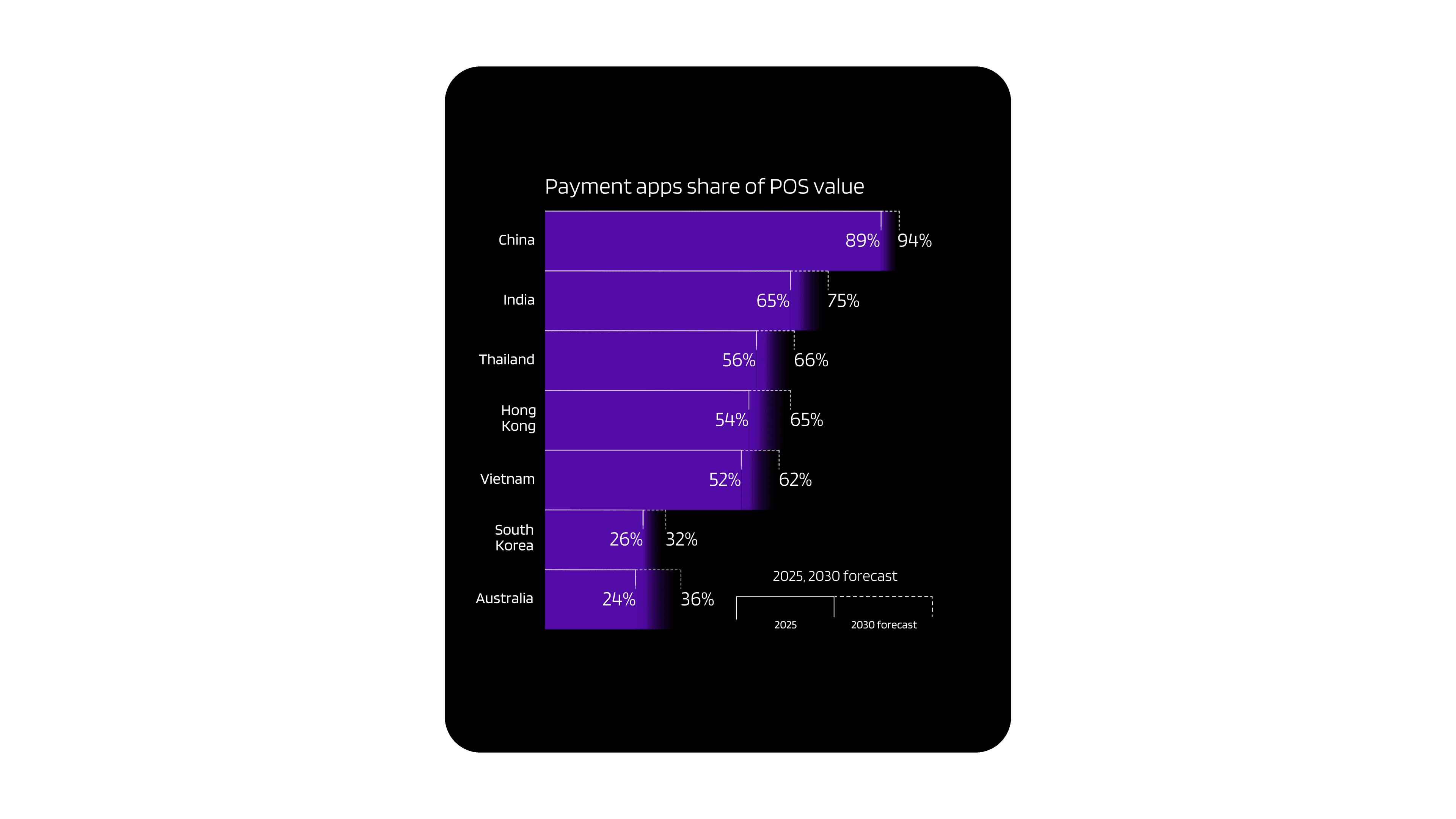
In many of these markets, QR codes have made it increasingly easy for both consumers and merchants to adopt app-based payments.
App payments are gaining traction in LATAM and EMEA
Other regions are moving in the same direction. In Latin America, QR code payments are rising, with strong use across the region including through Yape in Peru, Nequi in Colombia and Mercado Pago in Argentina.
In Europe, change is being driven by regulation, intensifying competition at the in-store checkout. For example, Apple’s agreement with the European Commission to open up NFC access to third-party wallets is enabling more providers to offer tap-and-go experiences. From PayPal launching in-store payments in Germany to Vipps in Norway and Bizum in Spain, Europe’s traditionally card-heavy POS market is now set for further digital innovation.
What do merchants need to know about the rise of app payments in-store?
Several forces are helping to bring payment apps to the in-store mainstream:
- QR codes are lowering barriers: They’re simple and cost-effective, making them especially powerful in APAC and LATAM with large mobile-first populations.
- Commerce revolves around the mobile: Smartphones are central to everyday life, so it’s natural they’re becoming pivotal to how people pay.
- Regulation is opening doors: Particularly in Europe, changes around NFC and open banking are creating more choices.
- Expectations have changed: People now expect the same speed and ease in-store as they get online.
Together, these factors are accelerating the move from traditional methods to app-based POS payments. For merchants, this shift creates both opportunity and complexity.
On one hand, offering the right payment methods at the in-store checkout can:
- Reduce friction
- Improve conversion
- Build customer loyalty
On the other hand, preferences vary by region and what works in one market may not work in the next. Success comes down to understanding which payment apps your customers actually use – and making them easy to adopt in-store.
Merchants that get this right will be better positioned to compete in an increasingly digital-first payment environment, whether they’re staying local, wishing to expand across borders or intend to go truly global.
The bigger picture: Payments are in perpetual motion
As new technologies, regulatory changes and consumer behaviors continue to evolve, the POS experience is being reshaped in real time.
The rise of payment apps in stores reflects a broader blurring of digital and physical commerce – where people can make purchases from anywhere, at any moment in their day.
“Payments are becoming one of the most fluid and important parts of the in-store experience, no longer necessarily anchored to the checkout,” says Alex Morgan-Moodie, head of vertical growth at Worldpay. “When people can pay through their own device using the apps they’re familiar with for online shopping, the experience can feel more instantaneous and emotive, unlocking greater value for merchants. We should expect the in-store experience to become even more digital and personalized in the future.”
Follow our insights series as we unpack each trend shaping commerce in constant motion. Download the Global Payments Report to explore how consumer payment preferences are evolving across 42 markets – and what it means for your business.
Related insights