Retail
3 minutes
GPR 2026 Trend 4: BNPL grows up
BNPL is evolving beyond the checkout, with providers expanding into wallets and broader financial ecosystems.
Key points
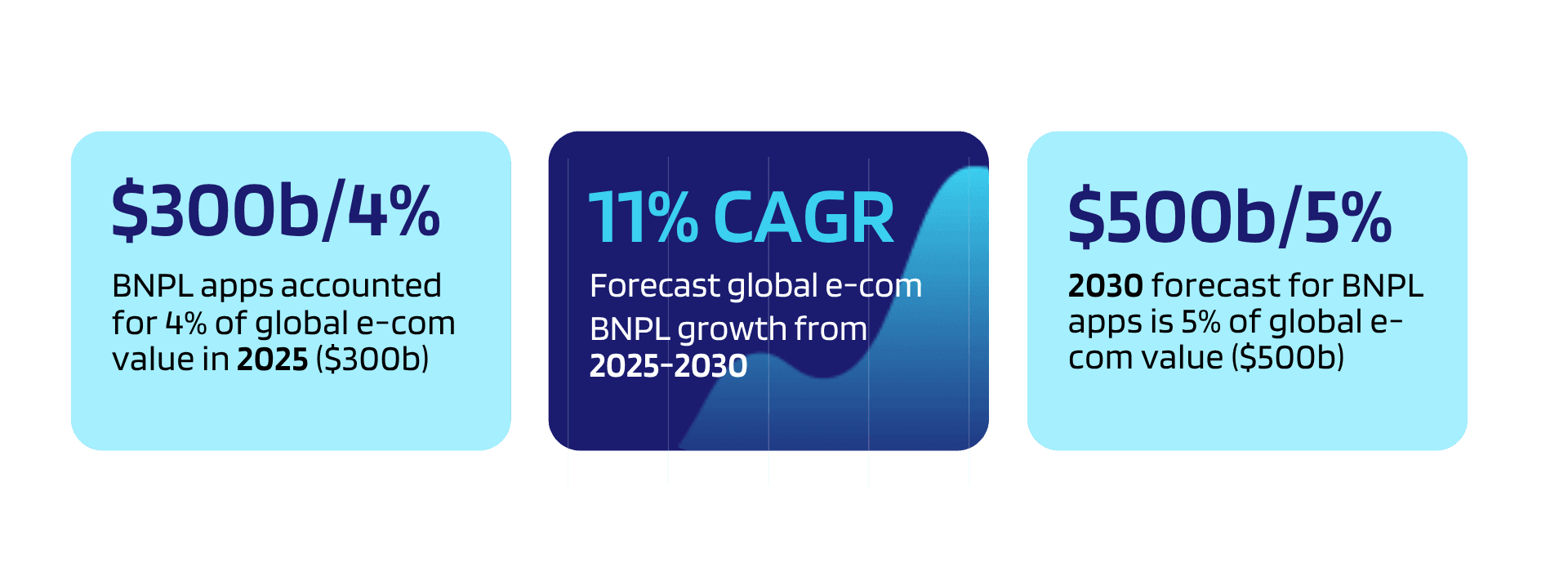
- BNPL apps are forecast to grow from $300 billion in global e-commerce value in 2025 to $500 billion by 2030.
- Once associated primarily with younger consumers, BNPL adoption is expanding across age groups and merchant categories.
- Competition is shifting beyond checkout as providers expand into wallets, banking products and rewards ecosystems.
- Flexible payment options are becoming increasingly embedded within everyday payment experiences.
- Merchants should focus on understanding where payment flexibility matters most to their customers.
Buy Now, Pay Later (BNPL) has become one of the defining payment innovations of the past decade. What began as a way to split purchases into manageable installments has evolved into a mainstream payment method used by consumers across a growing range of demographics, industries and markets. Today, BNPL apps account for $300b of global e-commerce value, and that figure is expected to grow to $500b by 2030.
While growth remains strong, though, the most interesting story isn’t how much BNPL is growing. It’s how it’s changing.
As adoption broadens, competition is diversifying. Leading providers are expanding into digital wallets, financial services and commerce ecosystems as they look to build deeper relationships with consumers. The GPR 2026 explores BNPL’s growth, success and future.
BNPL’s appeal keeps growing
The early success of BNPL was built on a simple promise: giving consumers greater flexibility and control over how they pay. Initially, much of the attention focused on younger consumers using installment payments for online retail purchases, and to manage their cash flow from month to month.
BNPL has become increasingly normalized, though, finding relevance across age groups and spending categories. Consumers are using flexible payment options for everything from fashion and electronics to home improvement purchases and travel bookings. For merchants, BNPL can help broaden payment choice while supporting acquisition and giving customers more flexibility at the point of purchase.
This broadening appeal has helped fuel continued growth, and accordingly, the payments landscape has become increasingly competitive.
Competition follows the consumer
As BNPL matures, many providers are expanding beyond installment lending into adjacent products and services, including:
- Debit and credit cards
- Rewards programs
- Savings accounts
- Account-to-account payments
- Shopping platforms
Increasingly, providers are looking to become part of consumers’ everyday financial lives. Affirm has expanded beyond BNPL to offer The Affirm Card, Affirm Money and even installments for rent payments. Block’s Afterpay issues the Afterpay Card and maintains its own shopping directory. Klarna is moving towards becoming a digital bank offering the Klarna Card and is also a shopping platform through which users can browse, buy and enjoy cash back on purchases without leaving the native app environment.
“The next phase of BNPL is about creating truly connected payment experiences,” says Anisha Mohammed, senior director for retail at Worldpay, now Global Payments. “The shopper should feel entirely in control and have flexibility at their fingertips. Whether they’re shopping online or in-store, modern consumers increasingly expect to have options to split payments when it works best for them.”
The wallet effect takes hold for BNPL
Another development is the growing convergence between BNPL and digital wallets.
Consumers increasingly expect financial services to be integrated into the payment experiences they already use every day. In response, installments are often offered within wallets via partnerships. For example, Apple enables BNPL options via partners in a pass-through model within Apple Pay.
For merchants, this evolution means flexible payment options neatly fit into payment experiences customers already regularly use and trust, without adding complexity to the checkout.
Consumers increasingly expect financial services to be integrated into the payment experiences they already use every day. In response, installments are often offered within wallets via partnerships. For example, Apple enables BNPL options via partners in a pass-through model within Apple Pay.
For merchants, this evolution means flexible payment options neatly fit into payment experiences customers already regularly use and trust, without adding complexity to the checkout.
What merchants should watch for next
The future of BNPL is unlikely to be defined by standalone installment products alone, though flexible payments are here to stay. As providers continue to expand into wallets, financial services and broader commerce ecosystems, the lines between payment methods are becoming increasingly blurred. Merchants who want to level up their payments should think beyond offering choice online and consider how flexible payment options fit into their wider customer journeys, wherever their customers are. Download the full GPR to explore payment trends across 40+ global markets.
BNPL is just one of the trends that keep payments moving. Explore the rest of our GPR 2026 trend series:
- Trend 1: Payment apps are moving to stores
- Trend 2: Glocalization is reshaping global commerce
- Trend 3: Digital wallets are winning on multiple fronts
Related insights