Retail
2 minutes
GPR 2026 Trend 3: Digital wallets are winning on multiple fronts
Digital wallets accounted for 56% of global e-commerce spend in 2025 and reflect local payment behaviors and digital ecosystems.
Key points
- Digital wallets accounted for 56% of global online and 33% of in-person spend in 2025.
- Digital wallets reflect local payment habits.
- For merchants, wallet strategy increasingly requires local knowledge of how consumers prefer to pay.
- Download the GPR 2026 to see how payment preferences are evolving across 40+ markets, and what it could mean for your business.
Digital wallets are central to global commerce
Digital wallets have moved well beyond just storing card details. They now reflect local payment systems, consumer behaviors and digital ecosystems across the globe. In many markets, they are central to how consumers shop and interact with brands both online and – increasingly – in-store.
The GPR 2026 shows just how far wallets have advanced. Globally, digital wallets accounted for 56% of online and 33% of in-person spending in 2025, making them the world’s leading payment method.
As their share of payments grows, so does the need to understand how they work and how they differ from one market to the next.
Wallets are enhancing cards, not replacing them
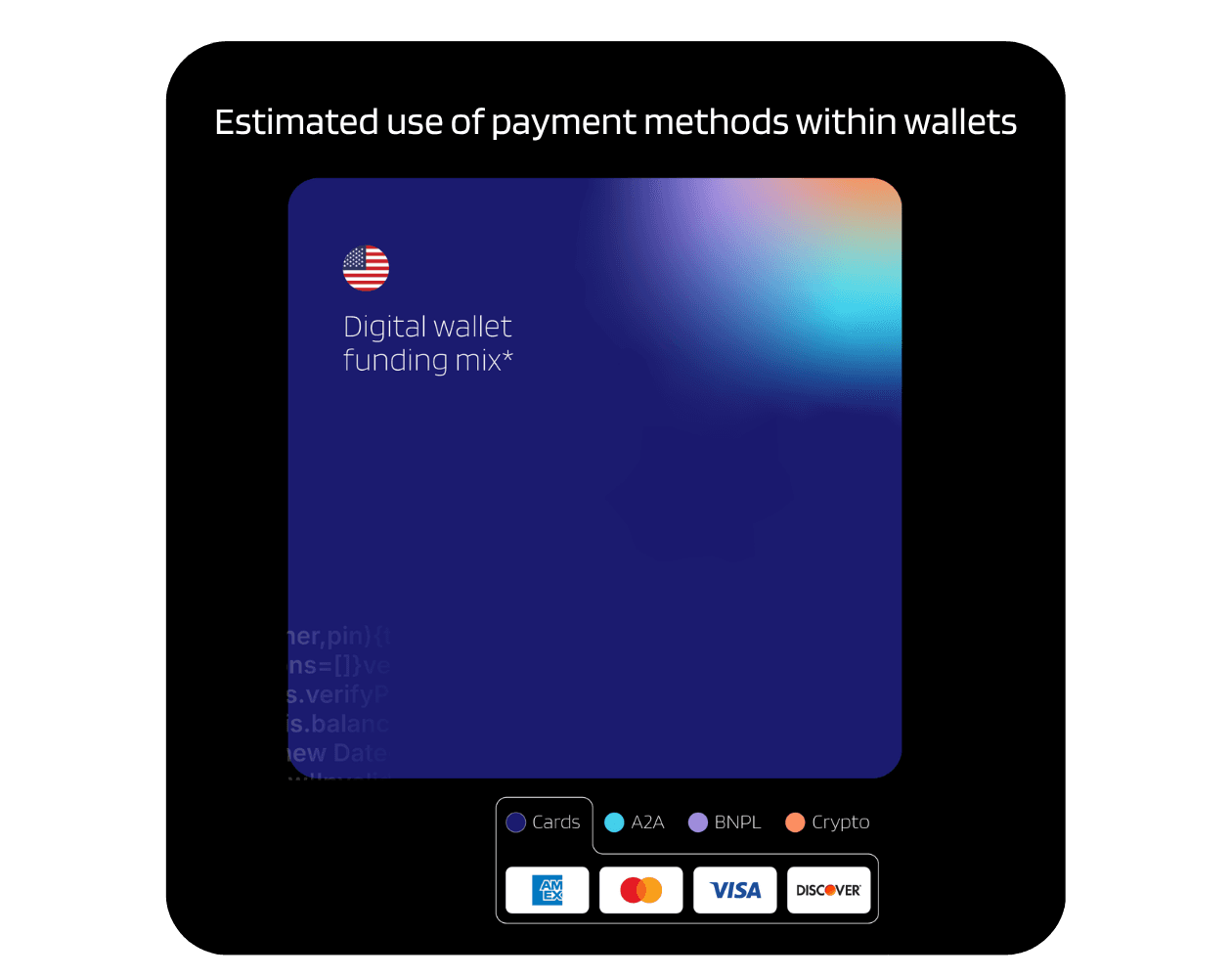
In card-led markets such as the UK, US and Australia, digital wallets like Apple Pay, Google Pay and PayPal are mainly funded by debit and credit cards. Even as wallets expand to include linked bank accounts, buy now, pay later (BNPL) and stored balances, cards remain a significant source of wallet spending.
Rather than replacing cards, digital wallets act as a fast and convenient way for customers to access them.
Digital wallets are adapting to local payment behaviors
Consumers are drawn to digital wallets because they’re fast, safe and easy to use, but their growth also reflects how well they fit into existing payment ecosystems.
As a result, wallets take different forms across global markets:
- In card-heavy markets like the US and the UK, wallets are a faster, more seamless way to use cards.
- In account-to-account (A2A)-led markets like India and Brazil, wallets connect directly to bank payment systems.
- In emerging ecosystem-driven markets like China and Indonesia, wallets may function as stored-value accounts or integrated multi-service platforms.
“For consumers, the experience often feels consistent. Behind the scenes, however, the underlying payment method can differ substantially,” says Marco Chardi, head of research at Worldpay, now part of Global Payments.
This flexibility is a major reason for global wallet growth. Rather than requiring consumers to change how they pay, wallets adapt to existing behaviors and infrastructure.
Superapps are extending the role of wallets
In a growing number of markets across Asia and Latin America, wallets are evolving beyond payments into wider digital environments known as “superapps.”
These platforms combine payments with services such as:
- Banking
- E-commerce marketplaces
- Messaging and chat
In China, Alipay and WeChat Pay are well-established examples that merge multiple aspects of daily life into a single app. Similar models are also emerging across Asia (Indonesia, Vietnam, South Korea) and Latin America (Brazil, Mexico), with platforms like Grab, Gojek, GCash, Kakao Pay, Naver Pay, and Mercado Pago expanding their networks.
In these environments, payments are embedded directly into broader customer journeys rather than existing as a separate step in the buying process.
This is particularly relevant in retail, where discovery, purchase and payment can all occur within the same platform instead of redirecting customers to separate environments.
As commerce becomes more digital and mobile-first, payments are becoming an integrated part of how consumers interact, shop and engage online.
The bigger picture: wallets are part of a changing payments mix
The rise of digital wallets sits alongside several broader trends highlighted in this year’s GPR, including the expansion of payment apps in stores and the global growth of local payment methods.
Together, these trends point to a payments landscape that is becoming:
- More mobile
- More localized
- More integrated into everyday digital experiences
Merchants expanding internationally can no longer treat digital wallets as a simple checkout add-on. Understanding how consumers use and fund wallets in different markets is an increasingly important part of a successful payments strategy.
Follow our insights series as we explore each trend shaping commerce in constant motion.
Download the GPR 2026 to see how payment preferences are evolving across 40+ markets, and what it could mean for your business.
Related insights